Message from the CFO
As of September 30, 2026
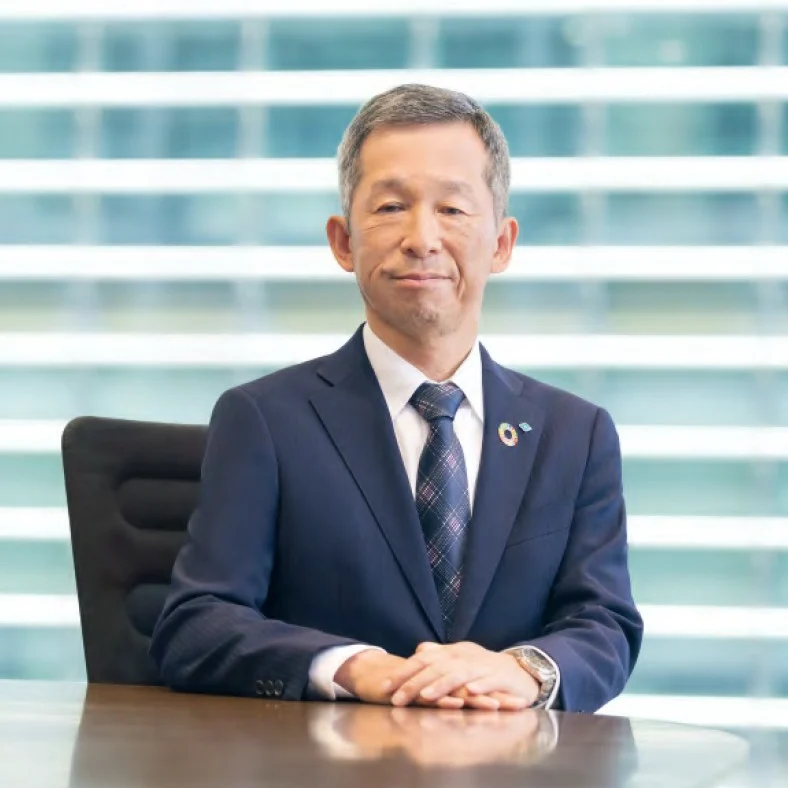
Motoyuki Sakai
Representative Director, Executive
Vice President
Global Corporate Strategy; Global Finance Administration; External Affairs; Corporate Governance; Corporate Communications; IT Management & Data Analytics
From Financial Restructuring to Driving Growth
Motoyuki Sakai
Representative Director, Executive Vice President
Global Corporate Strategy; Global Finance Administration; External Affairs; Corporate Governance;
Corporate Communications; IT Management & Data Analytics
From Financial Restructuringto Driving Growth
Rebuilding the financial foundation
In FY2023, the Company faced a significant deterioration in earnings as a structural imbalance became apparent, with costs exceeding revenues. The recognition of substantial losses significantly eroded shareholders’ equity and caused the equity ratio to decline sharply. In addition, the increased burden of interest-bearing liabilities constrained our financial capacity, making the rebuilding of our financial foundation an urgent management issue.
In this phase, we prioritized transforming our earnings structure to stably generate profits, reducing excess debt, and enhancing equity capital. Improving the Company’s financial soundness is not merely about restoring financial indicators; it is a prerequisite for rebuilding the foundation that enables us to continue investing for future growth.
To achieve this, we thoroughly optimized our business scale and cost structure. In addition to streamlining measures such as selection and concentration in R&D areas, a review of our workforce structure, and cost reductions, we reshaped our business portfolio, including the divestiture of the Asia business, and disposed of non-core assets, thereby reducing interest-bearing liabilities and improving the Company’s financial foundation.
None of the decisions underlying these measures was easy, but each was essential to ensure the continuity of our business and secure future growth opportunities. Rebuilding our financial foundation was not merely a defensive measure; it was a process of restoring the strategic flexibility needed to pursue the next stage of growth.
Balancing financial discipline and growth investments
The key objectives of Reboot 2027 were to achieve a stable profit structure and reduce interest-bearing liabilities. With those goals in mind, we steadily worked to improve the Company’s financial soundness. Based on this progress, we are charting a path to transition from the restructuring phase to a phase of renewed growth. However, streamlining efforts alone cannot deliver sustainable growth. Improving the Company’s financial soundness is not an end in itself but a means of getting the Value Creation Cycle moving again with greater momentum. To maintain and enhance competitiveness as a pharmaceutical company, it is imperative that we continue to invest in growth while carefully assessing what is financially sustainable.
Under the next phase, Boost 2028, we aim to accelerate growth by expanding investments in R&D and other growth initiatives while maintaining financial discipline.
In addition, when deciding on an investment, the timing is just as critical as the investment amount. If necessary investments are deferred excessively, the gap with competitors may widen to a point where regaining lost ground becomes increasingly difficult. On the other hand, clinical development is inherently uncertain, and we need to give due consideration to risks arising from dependence on key products, as well as changes in the market environment and competitive conditions.
Accordingly, as CFO, I place great importance on carefully assessing both the scale and timing of growth investments at all times. To achieve a balance between continuing to invest for growth and maintaining financial soundness, we have established ROE and the equity ratio as key management indicators under Boost 2028. Guided by these indicators, we will ensure disciplined decision-making that takes into account both capital efficiency and financial position.
Securing financial flexibility through a public offering
The public offering was an important capital strategy to ease financial constraints and secure the financial flexibility necessary for renewed growth. Its primary purpose was to establish a financial foundation that would enable us to seize the growth investment opportunities called for in Boost 2028 and make agile decisions when needed.
The issuance of subordinated debt and bank borrowings in connection with the business acquisition arising from our strategic alliance with Roivant was a reasonable decision under the circumstances at that time. Subsequently, however, the earnings outlook for the acquired business deteriorated, resulting in substantial impairment losses on goodwill and intangible assets. This increased financial constraints and made the refinancing of the subordinated debt increasingly uncertain. In addition, bank borrowings came to require parent company guarantees, further reducing our financial flexibility and limiting our freedom to access capital. Against this backdrop, the equity offering was a practical and important strategic decision to address these issues promptly, strengthen our balance sheet, and restore the financial flexibility necessary to support future growth.
A capital increase, however, results in share dilution. Over the medium-to-long term, I believe that executing necessary growth investments at the appropriate time and strengthening the Company’s future earnings base will contribute to enhancing shareholder value. What is important is that we allocate the funds raised in a disciplined manner and steadily translate those investments into enhanced corporate value.
Value Creation Cycle toward sustained growth
The foundation of sustainable growth lies in a virtuous cycle of investment and earnings generation. We will invest the funds generated from existing businesses into R&D and business opportunities that will become future sources of earnings and then draw on those results to generate further earnings. Keeping this cycle functioning continuously will lead to the rebuilding of the Value Creation Cycle.
To that end, we need to make growth investments on a continuous and timely basis while considering the optimal balance of profit, capital efficiency, and financial soundness. In Boost 2028, we have placed importance on ROE as an indicator of capital efficiency and on the equity ratio as a marker of financial soundness. Guided by these indicators, balancing growth investment with financial discipline will remain at the core of our management approach.
In terms of growth investments, it will be critical that we allocate growth capital primarily to areas and markets where we can leverage our strengths. Rather than spreading our limited management resources too broadly, we will concentrate our investments on opportunities where we can build competitive advantage and enhance corporate value over the long term. Finance plays a critical role in identifying and capturing growth opportunities while appropriately managing risk, thereby supporting disciplined investment decisions.
To our stakeholders
Having undergone a period of restructuring, the Company is now entering a new phase aimed at renewed growth. Going forward, a key priority will be to leverage our strengthened financial foundation and allocate capital appropriately to growth opportunities that enhance corporate value. As CFO, I am committed to maintaining an appropriate balance between growth investment and financial soundness, setting achievable targets, and demonstrating our progress and results with transparency and integrity.
I recognize delivering returns to shareholders as a key management priority. While we are currently prioritizing growth investments to advance Boost 2028, our objective is to strengthen a sustainable earnings base capable of generating long-term cash flows. By steadily enhancing this earnings base through disciplined growth investments and allocating the resulting cash flows appropriately between reinvestment and shareholder returns, we will continue to drive our Value Creation Cycle and achieve sustainable growth in corporate value over the medium to long term.